
H3C · Network Router
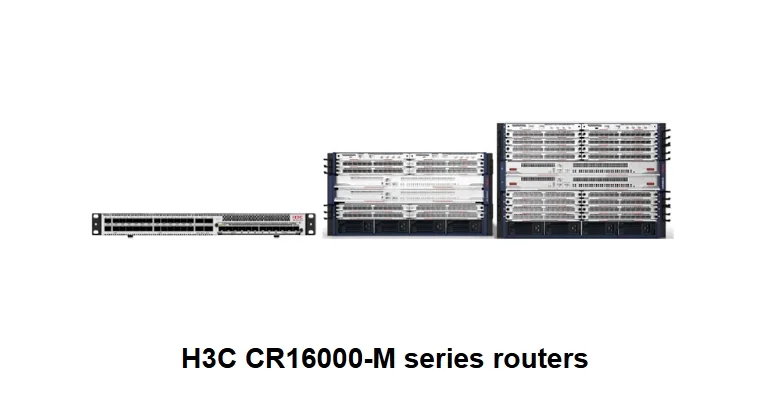
H3C CR16000-M1A 100G/40G/10G Ports High-End Cloud Core SRv6 & FlexE Support Carrier-Grade Router
Model: CR16000-M1A|Condition: Original New|Warranty: 1 year
H3C CR16000-M1A — a network router shipped from ImportGM's Shenzhen warehouse to channel partners, integrators and corporate IT departments worldwide. H3C CR16000-M routers are digital era-oriented cloud service routers applicable to government, finance, transport, power grid, healthcare, education, and carriers. With a carrier-level HA and programmable NP architecture design, the router provides abundant features to process cloud services, carrier-level high availability, and exceptional forwarding capacity. Core parameters include switching capacity 640Gbps, independent fan trays Three independent fan trays in redundancy. Original New units carry the 1 year ImportGM warranty; quotation, proforma invoice and export packing list are issued the same day.
- ✔iFIT, which provides visible service quality display and fast troubleshooting.
- ✔Abundant cloud services
- ✔Supports SRv6, which allows one-hop access to the cloud and simplifies service provisioning.
- ✔Carrier-level high availability
- ✔Supports MPU and switching fabric module 1+1 redundancy.
- ✔Supports front-to-rear airflow and supports redundant fan trays that provide 12 fans in total.
Bulk pricing available · Export packing & documentation · DHL / FedEx / air / sea freight
Technical Specifications
| Switching Capacity | 640Gbps |
|---|---|
| Chassis | Integrated chassis, which can be installed in a 19-inch rack |
| MPUs | Fixed-port router |
| Line cards | Fixed port + 1 Flexible card |
| Independent switching fabric modules | Fixed-port router |
| Cooling | Front-to-rear airflow |
| Independent fan trays | Three independent fan trays in redundancy |
| Power system | Two independent power supplies in redundancy, supporting AC/DC/HVDC |
| MTBF | 35 years |
| MTTR | 0.5 hours |
| Dimensions (H × W× D) | 44 × 440 × 435 mm (1.73 × 17.32 × 17.13 in, 1 RU) |
| Ports | FE, GE, 10GE (LAN/WAN), 100GE, 155M POS, 622M POS, 2.5G POS, CPOS, ATM, and E1/T1 ports Interface type changing between 100GE and 40GE Interface type changing between 155M POS, 622M POS, and GE Interface type changing between ATM/ and POS |
| Unicast routing | IPv4/IPv6 dual stack IPv4 FIB table with up to 4M entries IPv6 FIB table with up to 1M entries IPv4 Routing table with up to 25M entries IPv6 Routing table with up to 12M entries Static routing, RIP, RIPng, OSPF, OSPFv3, IS-IS, IS-ISv6, BGP, and BGP4+ VRRP and VRRPv3 IPv6 neighbor discovery, PMTU discovery, TCP6, ping IPv6, traceroute IPv6, socket IPv6, static IPv6 DNS, specified IPv6 DNS server, and TFTP IPv6 client IPv4 to IPv6 transition ICMPv6 MIB, UDP6 MIB, TCP6 MIB, and IPv6 MIB ECMP and UCMP Policy-based routing Routing policy Tunnels such as GRE Static routing FRR, OSPF FRR, ISIS FRR, and BGP FRR |
| Multicast | Routing protocols, including PIM-DM, PIM-SM, PIM-SSM, MSDP, MBGP, and Anycast-RP IGMPv1/v2/v3 and IGMP snooping v1/v2/v3 PIM6-DM, PIM6-SM, and PIM6-SSM MLDv1/v2 and MLD snooping v1 Multicast policy and multicast QoS |
| MPLS VPN | MPLS label distribution protocols such as LDP and RSVP-TE P/PE compliant with RFC 2547bis Three inter-AS MPLS VPN methods (option1/option2/option3) HoPE Multi-role host L2VPN, L3VPN, inter-AS L2VPN and L3VPN MPLS TE FRR and LDP FRR, with a switchover time of not more than 50ms 6PE and 6vPE Distributed multicast VPN ACL, which identifies traffic and forwards the traffic to different VPNs MPLS VPN network troubleshooting features, including MPLS ping and MPLS traceroute L2VPN access to L3VPN Access to VPLS via QinQ |
| BRAS service | PPPoE, PPPoEoVLAN, and PPPoEoQ access authentication Layer 2 portal, Layer 3 portal, and QinQ portal access authentication IPoE, IPoEoVLAN, and IPoEoQ access authentication Leased access authentication such as subnet-leased, interface-leased, and L2VPN-leased access authentication L2TP Layer 2 transparent access and Layer 3 transparent access RADIUS, TACACS, and COPS protocols iTA, which differentiates services by destination addresses to perform accounting, bandwidth control, and QoS Unified wired and wireless authentication solutions, which meet the demands for massive user access and wireless client mobility BRAS IRF, which offers redundancy and simplifies Ops |
| ACL | IPv4 and IPv6 ACL and EACL Ingress/Egress ACL Hardware-based ACL |
| QoS | HQoS Queue scheduling mechanisms such as PQ, WFQ, and CBWFQ More granular and flexible traffic control through HQoS Traffic shaping Congestion avoidance technologies such as tail drop and WRED drop Priority marking and remarking 802.1p, TOS, DSCP, and EXP priority mappings Congestion avoidance, traffic policing, and traffic shaping Data packet marking based on IP addresses, port numbers, 802.1P, and DSCP values Data packet multilevel queue mechanisms include CQ, PQ, LLQ, and WFQ Multicast QoS |
| Ethernet features | 802.1Q Ethernet Virtual Circuits ( EVC) ARP 802.1Q VLAN trunk QinQ VLAN encapsulation QinQ termination MAC address limit 802.3d (STP)/802.3w (RSTP)/802.3s (MSTP) IEEE 802.3ad (link aggregation), static link aggregation, and link aggregation across different modules Aggregation of ports with different transmission rates Port mirroring and flow mirroring FlexE Channelized sub-interfaces |
| SDN technologies | VXLAN and EVPN PCEP protocol Network information collection protocols such as BGP-LS NETCONF and YANG MPLS SR and SRv6 CBTS OpenFlow BGP FlowSpec Telemetry 5G bearer network technologies such as EVPN, SRv6, and 1588v2 |
| Traffic analysis | NetStream, which supports the version 5, version 7, and version 9 data export formats, sampling, and flow statistics Multi-log host Hardware-based NTA IPv4/IPv6/MPLS traffic collection and analysis Traffic collection and analysis in the inbound and outbound directions of interfaces Abnormal traffic detection and monitoring |
| High availability | MPU, switching fabric module, power module, and fan tray redundancy Separation of the control plane and switching plane Independent switching fabric modules Automatic fan speed adjustment Hot swapping for all components, and hot swapping of switching fabric modules without removing fan modules Built-in DC and AC power modules, which can be installed on the same router and do not occupy service slots NSF, NSR, and GR BFD, which supports fast failure detection and a switchover time of not more than 50ms iFIT, which can detect network failures in real time, troubleshoot the network failures, and implement visible management over performance data |
| System management | In-band and out-of-band network management Console/AUX Modem/Telnet/SSH2.0 CLI-based configuration FTP, TFTP, XMODEM, and SFTP file uploading and downloading management SNMP v1/v2/v3 RMON v1/v2 (groups 1, 2, 3, and 9) NTP NQA Fault alarms and self-healing DHCP Data logs ICMP Syslog Traceroute Multithreading access to the device via Telnet 1588v2 |
| Operating temperature | 0°C to 45°C (32°F to 113°F) |
| Regulatory compliance | Directive2014/30/EU EN55032ClassA, EN 55024\EN 55035 EN 60950-1, EN61000-3-2, EN61000-3-3 IEC 60950-1 UL 60950-1 |
Product Overview
H3C CR16000-M routers are digital era-oriented cloud service routers applicable to government, finance, transport, power grid, healthcare, education, and carriers. With a carrier-level HA and programmable NP architecture design, the router provides abundant features to process cloud services, carrier-level high availability, and exceptional forwarding capacity.
With high-density 100GE, 10GE, and GE ports and 155M/622M/2.5G POS, CPOS, and E1/T1 WAN ports, the routers can be deployed at different network positions. The router runs the state-of-the-art Comware network operating system, which is open, containerized, and programmable to meet user requirements in new businesses.
SRv6, which provides customized programming, global control and scheduling, open network construction, simplified Ops deployment, and visible display in cooperating with AD-WAN controllers.
FlexE and channelized sub-interfaces, which meet the network slicing requirement at different layers, allowing for strict isolation of different services and SLA for key services.
Supports iFIT and Telemetry, enabling service status report in real time and granular network monitoring for refined management and effective service assurance.
Supports AD-WAN carrier and branch network solutions, enabling network intelligent scheduling and refined management and prediction of network trends through service emulation and failure testing.
Related Network Routers
H3C
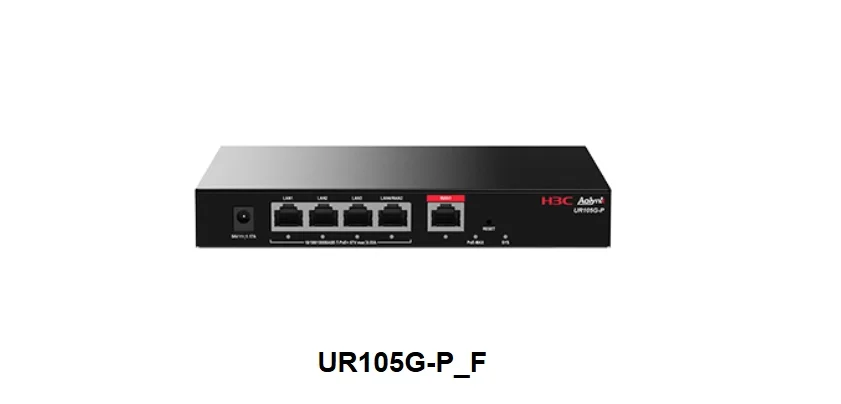
Aolynk UR105G-P_F
H3C Aolynk UR105G-P_F high-performance enterprise PoE gateway

H3C
Aolynk UR105G-P_FL
H3C Aolynk UR105G-P_FL high-performance enterprise PoE gateway

H3C
Aolynk UR105G-P_FR
H3C Aolynk UR105G-P_FR high-performance enterprise PoE gateway
H3C
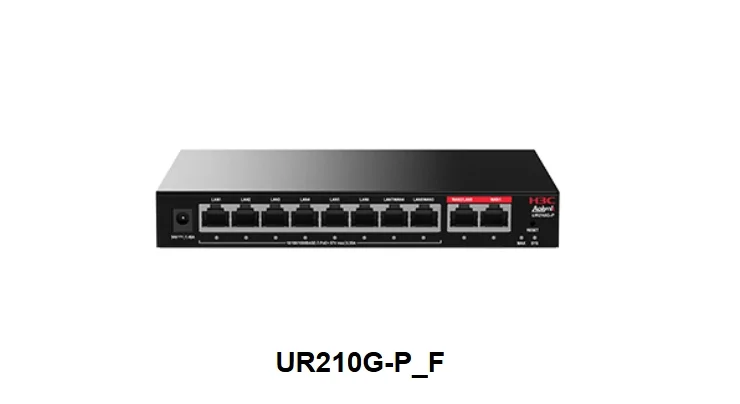
Aolynk UR210G-P_F
H3C Aolynk UR210G-P_F high-performance enterprise PoE gateway
H3C
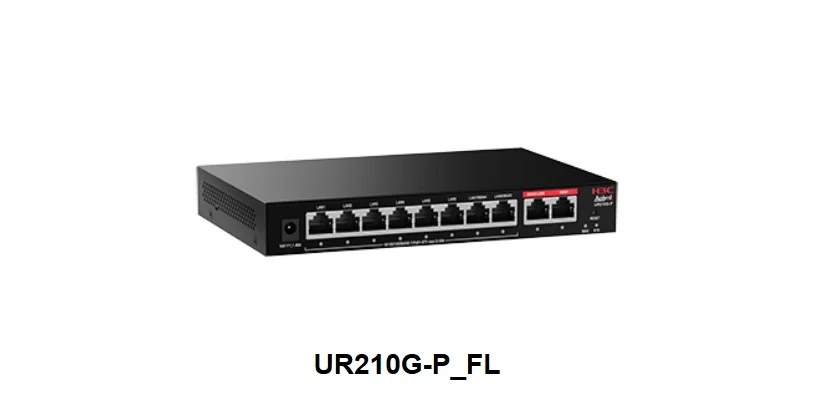
Aolynk UR210G-P_FL
H3C Aolynk UR210G-P_FL high-performance enterprise PoE gateway

H3C
Aolynk UR210G-P_FR
H3C Aolynk UR210G-P_FR high-performance enterprise PoE gateway
About Network Routers from ImportGM
Enterprise routers and SD-WAN edge platforms — Cisco ISR/ASR, Huawei AR/MSR, H3C and MikroTik — for branch, campus WAN and carrier edge.
Browse all Network Routers →