
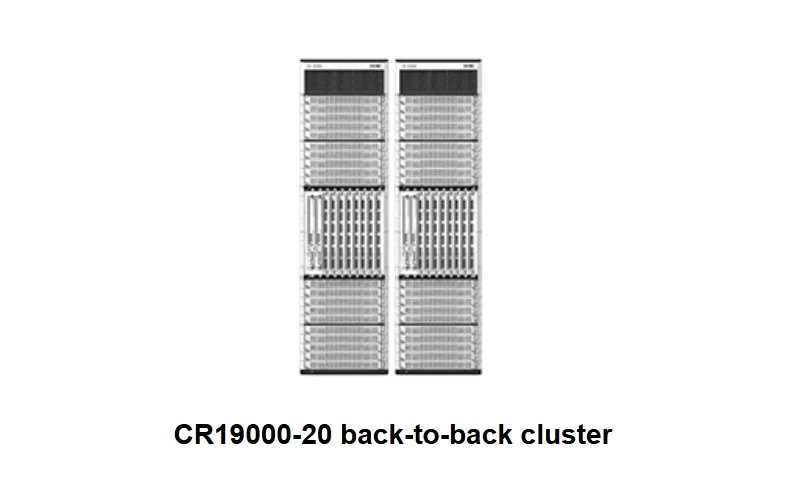
H3C · Network Router
H3C CR19000-20 back-to-back cluster Data Center Core High-Speed Enterprise Router
Model: CR19000-20 back-to-back cluster|Condition: Original New|Warranty: 1 year
ImportGM supplies the H3C CR19000-20 back-to-back cluster, a network router built for campus, branch and data centre networks, to distributors, system integrators and enterprise IT procurement teams across Europe, North America and the Middle East. The CR19000 router adopts the most advanced fourth-generation non-blocking CLOS switching architecture, which enables data to be transmitted at a super high speed with low latency. Support for variable-length cell switching significantly improves operation efficiency of the overall cluster. Core parameters include switching capacity 43.2 Tbps, system aggregated throughput 14.4 Tbps. Original New units carry the 1 year ImportGM warranty; quotation, proforma invoice and export packing list are issued the same day.
- ✔H3C CR19000-20 back-to-back cluster
- ✔Ultra-large capacity and unlimited expansion
- ✔Open architecture and SDN-oriented design
- ✔Two-drive RAID configuration enhances data availability.
- ✔High availability and enhanced security
- ✔The industry-leading environment-friendly and sustainable design greatly increases the energy efficiency and ensures smooth upgrade.
Bulk pricing available · Export packing & documentation · DHL / FedEx / air / sea freight
Technical Specifications
| MPU slots | 2 |
|---|---|
| Switching fabric slots | 6 |
| line-card slots | 8 |
| Switching capacity | 43.2 Tbps |
| System aggregated throughput | 14.4 Tbps |
| Power module | 8 power modules per chassis support for redundancy and smart power management |
| Fan trays | 6 fan trays per chassis support for redundancy and smart heat dissipation |
| Dimensions (H × W × D) | 843 × 440 × 743 mm (33.19 × 17.32 × 29.25 in), 19 RU |
| Operating temperature | 0°C to 45°C (32°F to 113°F) |
| Operating humidity | 5% to 95%, non-condensing |
| Operatingaltitude | –60 m (–196.85 ft) to +5000 m (+16404.20 ft) |
| Ports | 1000BASE-X-SFP fiber ports 10GBASE-R/W-SFP+ fiber ports 40GBASE-R-QSFP+ fiber ports 100GBASE-R-CFP2 fiber ports 100GBASE-R-QSFP28 fiber ports POS-OC192c/STM64c-XFP fiber ports POS-OC48c/OC12c/OC3c-SFP fiber ports |
| EMC standards | FCC Part 15 (CFR 47) CLASS A ICES-003 CLASS A VCCI-3 CLASS A VCCI-4 CLASS A CISPR 22 CLASS A EN 55022 CLASS A AS/NZS CISPR22 CLASS A CISPR 24 EN 55024 EN 61000-3-2 EN 61000-3-3 EN 61000-6-1 ETSI EN 300 386 EN 301 489-1 EN 301 489-17 |
| Safety standards | UL 60950-1 CAN/CSA C22.2 No 60950-1 IEC 60950-1 EN 60950-1/A11 AS/NZS 60950 EN 60825-1 EN 60825-2 FDA 21 CFR Subchapter J GB 4943 |
| Interfaces | GE, 10GE, 40GE, and 100GE interfaces OC-192c/STM-64c POS interfaces POS-OC48c/OC12c/OC3c-SFP interfaces |
| Data link layer | PPP, HDLC Ethernet link aggregation, port mirroring DLDP |
| QinQ | VLAN termination |
| Traffic statistics | Traffic statistics on both the incoming and outgoing traffic |
| QoS | Priority marking/remarking CAR (Ingress/Egress) CBQ Congestion management Queue scheduling QoS policy (applied on an interface, globally, and on the control plane) Dynamic modification of QoS policies QPPB |
| ACL | Ingress/Egress ACL Basic ACLs, advanced ACLs Applying an ACL to an interface or globally |
| IPv4 protocol | TCP, UDP, RawIP, Ping, Traceroute Telnet, FTP, TFTP ICMPv4 DNS DHCP NTP ARP, ARP Proxy |
| IPv6 protocol | Dual IPv4 and IPv6 protocol stacks TCP6, UDP6, RawIP6, Pingv6, Traceroute6 Telnetv6, FTPv6, TFTPv6 DNS6 ICMPv6 VRRPv3 DHCPv6 ND PMTUD (IPv6) 6PE |
| IPv4 routing protocol | RIPv1/v2 OSPFv2 IS-IS BGPv4 IPv4 static routing/routing policy/route recursion/policy-based routing |
| IPv6 routing protocol | RIPng OSPFv3 IS-IS6 BGPv4+ IPv6 static routing/routing policy/route recursion/policy-based routing |
| Layer 3 multicast | Static multicast routes IPv4 intra-AS multicast routes IPv4 inter-AS multicast routes IPv4 multicast group management IPv6 intra-AS multicast routes IPv6 multicast group management Multicast VPN |
| Interconnect | VXLAN |
| MPLS | Basic MPLS MPLS L3VPN VPWS/VPLS 6VPE MPLS TE P2MP |
| SDN | BGP-LS BMP Flowspec Segment routing OpenFlow PCEP |
| Device security | Protection against data packet-based attacks Protection against protocol packet-based attacks Attack detection Protection of protocol packets Diagnosis on packet transmitting and receiving |
| Network security | Packet validity check uRPF Packet filtering ARP attack protection Protocol-based traffic limiting NetStream |
| User security | Device management security AAA SSH |
| Device management | CLI management by accessing the device through console port, Telnet, or sTelnet (SSH) |
| File management | Uploading/downloading files through FTP/TFTP Formatting files Creating, copying, deleting, saving files and directories |
| Network maintenance | Ping TraceRoute LSP Ping/Tracert Loop detection on a port |
| Network management and monitoring | SNMPv3 IMC LLDP/LLDP-MED MIB PTP |
| High availability | Hot swapping of cards Redundancy of switching fabric modules Active/standby switchover Hot patching GR NSR VRRP, VRRPE BFD for VRRP/BGP/IS-IS/RIP/OSPF/static routing IP FRR |
Product Overview
The CR19000 router adopts the most advanced fourth-generation non-blocking CLOS switching architecture, which enables data to be transmitted at a super high speed with low latency. Support for variable-length cell switching significantly improves operation efficiency of the overall cluster.
On a single CR19000 with 1800G capacity on each slot, each port can provide a capacity as high as 400Gbps. The router supports a maximum of 360 100G ports and this number will be continuously increased.
The CR19000 supports multiple cluster modes, such as back-to-back, 2+6, and 3+12, and supports cascade of up to 12 chassis. Smooth expansion from a single chassis to a cluster protects users' investment
Innovative electromechanical designs allow quick chassis disassembly without using tools, facilitating memory expansion and standard PCIe device installation.
Modular, redundant, and hot swappable designs for components such as power supplies and fan trays and the front-to-rear air aisle make the device highly available and easy to maintain.
Advanced distributed architecture—With separated routing, service, and switching engines, the failure of a single hardware component does not affect the operation of the whole system. The separation of control plane and service plane prevents service processing and system control from affecting each other and ensures service continuity during active/standby switchover. Support for N+M redundancy of switching fabric modules guarantees line-speed traffic forwarding during switching fabric module replacement.
Related Network Routers
H3C
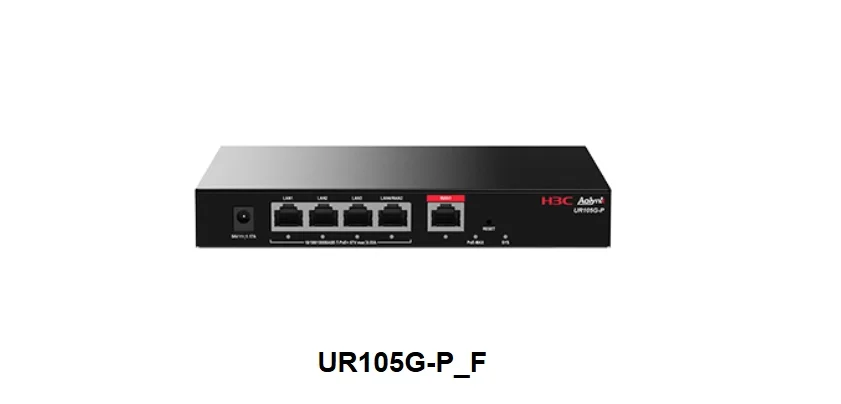
Aolynk UR105G-P_F
H3C Aolynk UR105G-P_F high-performance enterprise PoE gateway

H3C
Aolynk UR105G-P_FL
H3C Aolynk UR105G-P_FL high-performance enterprise PoE gateway

H3C
Aolynk UR105G-P_FR
H3C Aolynk UR105G-P_FR high-performance enterprise PoE gateway
H3C
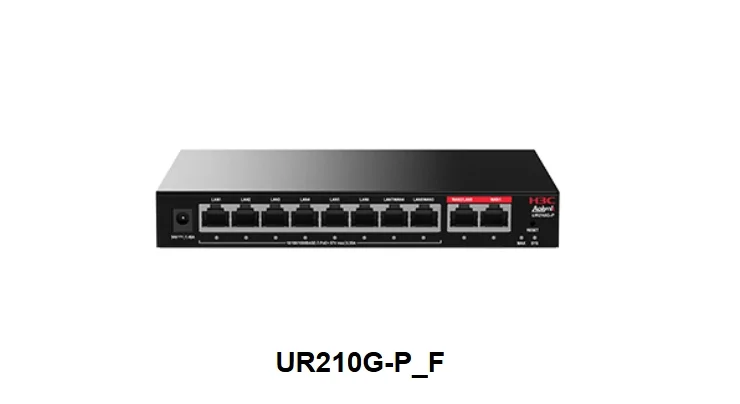
Aolynk UR210G-P_F
H3C Aolynk UR210G-P_F high-performance enterprise PoE gateway
H3C
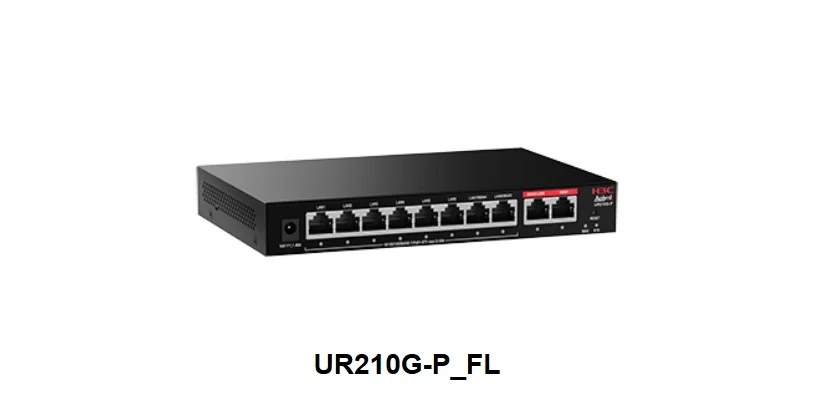
Aolynk UR210G-P_FL
H3C Aolynk UR210G-P_FL high-performance enterprise PoE gateway

H3C
Aolynk UR210G-P_FR
H3C Aolynk UR210G-P_FR high-performance enterprise PoE gateway
About Network Routers from ImportGM
Enterprise routers and SD-WAN edge platforms — Cisco ISR/ASR, Huawei AR/MSR, H3C and MikroTik — for branch, campus WAN and carrier edge.
Browse all Network Routers →